Shadow AI (part 2)
August 12, 2026

In my previous blog post, I shared the growing challenges of managing Shadow AI. In this blog post, I take a deeper dive into potential solutions. Most organizations embrace systems thinking in which they explore, identify, build, and monitor goal-oriented workflows and systems to solve challenging problems. In the case of Shadow AI, organizational leadership will frequently lean into enterprise-wide systems that reduce, if not eliminate, opportunities and loopholes that lead to a growing unmonitored Shadow AI ecosystem. These include policies, procedures, penalties, monitoring tools, metrics, and workflows designed to halt Shadow AI in its tracks. While systems are necessary, they are not sufficient. It is the failure of systems that led to Shadow AI in the first place. Therefore, more systems are unlikely to solve the problem, although they can serve as a starting point to contain Shadow AI. Instead, we need to take a comprehensive human-in-the-loop approach to manage Shadow AI.
As I mentioned in the previous blog post, Shadow AI is rarely driven by malfide intentions to violate rules or protocols or make risky moves. Instead, it is often driven by personal ambitions and good intentions. Employees are eager to prove that they are creative and highly productive. They want to show that their ROI is on an upward trajectory. They are eager to prove to their bosses that they have the skills and abilities to handle an increasing number of complex projects that may demand deep knowledge about market dynamics, comprehensive data analysis, and dashboards that display the interconnections between many moving parts. The more ambitious and productive the employee, the more eager they are to deliver more quality products at a rapid clip. Shadow AI frequently is their partner in their ambition to deliver better and quicker results.
Organizations can support these employees by being more agile in their decisions to acquire the tools that employees need to deliver great results. Below are the core elements of a comprehensive and sustainable approach to addressing the challenges of underground AI.
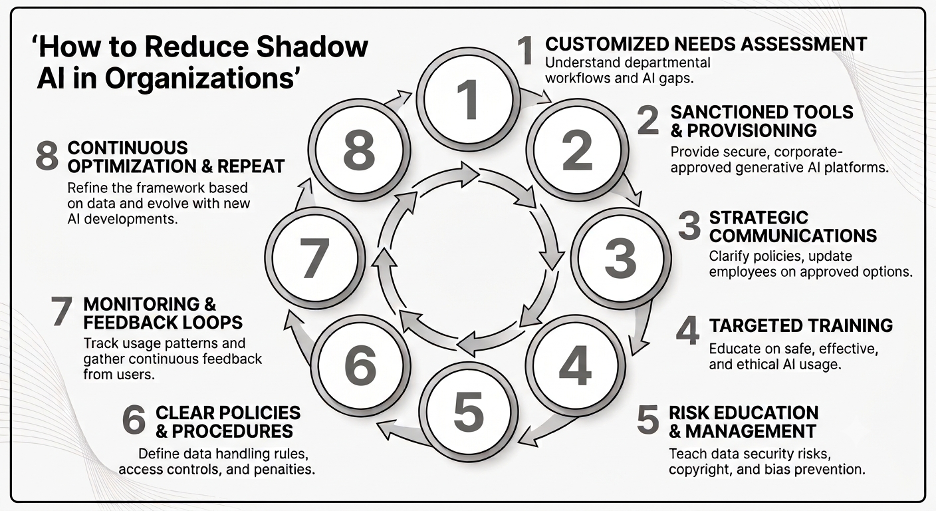
- Customized Needs Assessment
- Sanctioned Tools to Meet Needs
- Communications
- Training
- Risk education and management
- Policies & Procedures
- Monitoring and Feedback loops
- Repeat
Let us explore each step. Needs assessment must be ongoing. One AI tool does not fit all, and even if it did, with the rapid pace of new tools, keeping up with the market requires continuous employees need assessment. This also sends the message to employees that senior leadership is committed to giving them the tools they need to succeed.
Needs assessment must be followed with increasing by expanding the pool of sanctioned tools. Employees want to see that their survey responses and discussions of their AI needs led to action.
Communications, Training, and Risk education and management are interrelated. Communicate frequently with employees about why some of their favorite tools may not meet pass muster and why risk is not a “legal” matter alone – instead, proper risk management is the foundation of economic success, job guarantees, and reputation and brand management.
Most communications end up being jargon-filled written in pseudo legal language. This doesn’t inspire confidence in employees, nor does it encourage them to avoid Shadow AI.
Real, honest, ongoing communication about what, why, when and how is what employees want. Finally, monitoring the gaps and continuing to seek feedback is critical. If it feels like a lot of work, it is. But there is no backdoor to security and trust. This cycle has to be repeated. It is not a one-time do it and be done activity. It is an ongoing pursuit of aligning employee needs with the right tools to nurture your employees’ growth and pride in their work.